





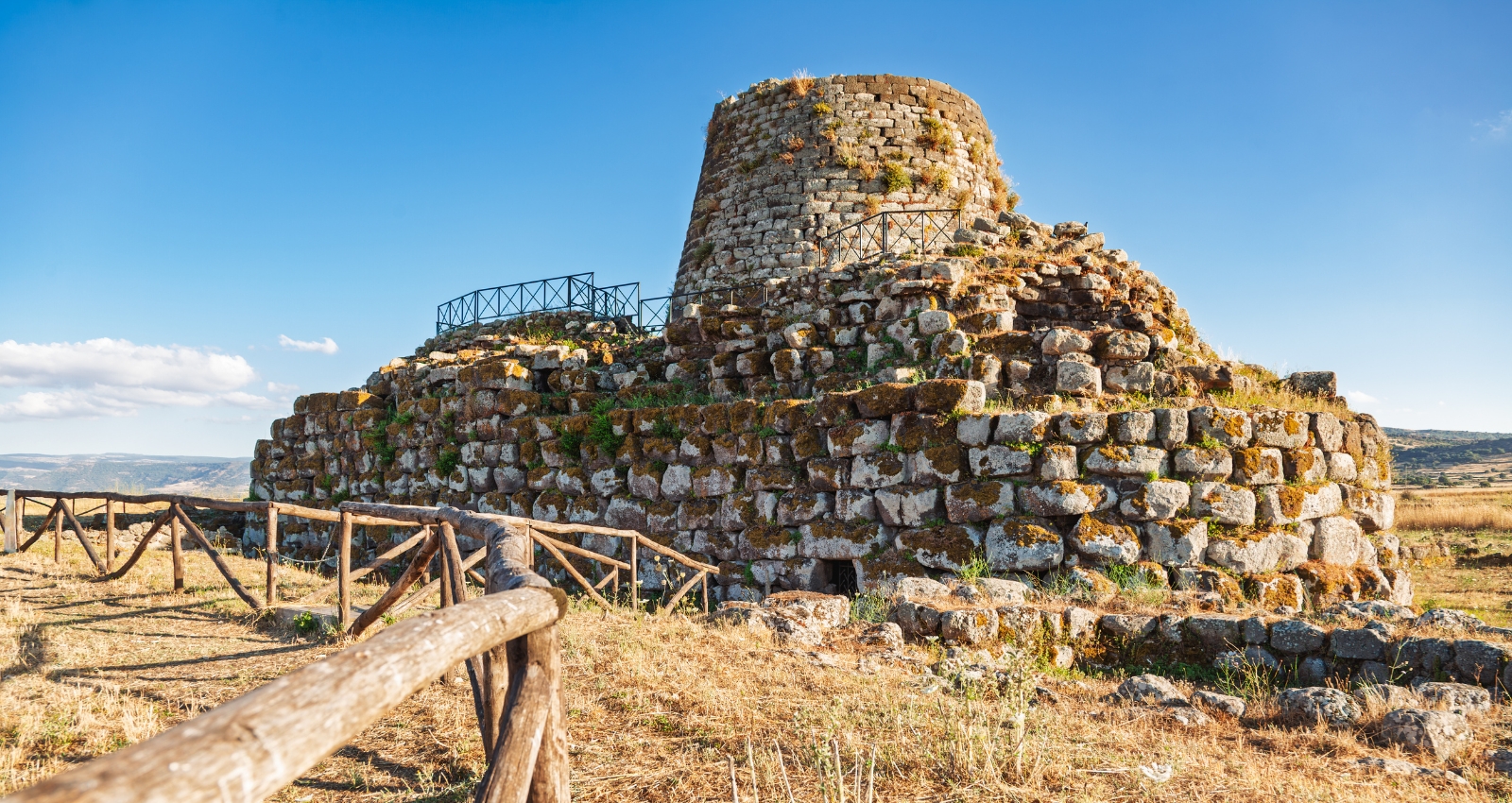
From the prehistoric towers of the interior to the Bronze Age villages, an archaeological heritage unique in the Mediterranean offers itineraries for small groups and international travellers. €33.5 million has been allocated to enhance the sites and improve hospitality.
A Sardinia far from the trendiest beaches of the Costa Smeralda, flowering instead into a cultural journey that lets us grasp how the land of the Mediterranean’s second-largest island has indeed adapted to modern tourism while preserving extraordinary relics at its heart. The story of the nuraghi spans a journey three thousand years long. It is that past which leads every traveller to the discovery of a civilisation capable of leaving its mark through countless monuments in basalt stone.
In short, it is worth speaking of the Sardinia of the nuraghi — and speaking of it again, because despite their unimaginable beauty these ancestral monuments are somehow undervalued. Undervalued, at least if we think of the great numbers that similar archaeological sites such as Stonehenge or Newgrange bring to inbound tourism in the Republic of Ireland and the United Kingdom, which have each worked to the utmost to enhance a single monument. In Sardinia there are thousands of them. And if we consider Su Nuraxi di Barumini, the most visited nuragic site on the Sardinian island, it welcomes around 100,000 visitors a year. By comparison, the Palace of Knossos, built in Crete in the 2nd millennium BC, recorded over a million visitors for the first time in 2024. The debate over the Costa Smeralda beaches still being preferred to the nuraghi has caught the attention of the national press too: Il Post wrote about it here, in an article that helps us reflect on the limits and the great opportunities of a tourism product that — we repeat — is still undervalued. The opportunities, in this case, naturally correspond to a slow, unstressful kind of tourism, far from the serpentine queues and crowds of tourists.
The nuraghi are the great megalithic structures of the Bronze Age that dot the interior of the Sardinian land, often set in rural landscapes little frequented by international tourism circuits.
For international tour operators, taking better stock of this heritage coincides with the chance to build archaeological itineraries for small groups that can be accompanied by specialised guides.
Among the operators offering excursions to discover the nuraghi, a few of the best-known are worth mentioning. There is Sardinia Tourist Guide, which organises private visits to Su Nuraxi di Barumini and the Giara plateau; or Genna Tours, specialising in small-group itineraries departing from Cagliari; and Secrets of Sardinia, which combines visits to the archaeological sites with the discovery of the island’s natural heritage. All offer guide-led experiences aimed also at international visitors, with multilingual packages well reviewed on the platforms.
There are many ingredients to combine in order to satisfy the tourist visiting the nuraghi: history, an ancient and pristine landscape, a multitude of local traditions. The nuraghi allow for a different experience — an interlude, or a complete break, from the usual all-beach stays on the island. We are far from the ultra-luxury of Cala di Volpe, and let us not forget that visits of this kind also suit the shoulder seasons.
Supporting the promotion of this offer is the Rete Sardegna Nuragica project, which involves 32 municipalities and has a regional allocation of €33.5 million, not yet fully spent. The resources are intended for the conservation and safeguarding of the monuments, for improving accessibility and hospitality, for digitalisation and for the development of new tools for visits. This substantial figure points, with some certainty, to a tourism offer set to improve and to become even more accessible for both operators and tourists.
An itinerary among the stone giants
A possible multi-day experience can begin in the southern interior, at Orroli, in the province of Cagliari, where the Nuraghe Arrubiu stands — known as the Red Giant. The complex, characterised by a large central tower and a system of further towers and courtyards, offers insight into how nuragic settlements were organised. Here the Is Janas cooperative comes in, offering guided visits, archaeological activities and, for groups by reservation, night visits. For this site too, a project worth as much as €900,000 was approved last October to improve services and access routes.
Speaking of Is Janas — still in the Cagliari area, a few steps from Su Stampu ‘e su Turrunu, a 16-metre-high waterfall gushes from an opening in the rock, and it is here that the eponymous Is Janas caves are found. These cavities, 240 metres long, are wrapped in an aura of mystery, with a few legends in their keeping that describe the caves as possessed by fairies.
Moving towards the centre of the island, at Abbasanta, the Nuraghe Losa preserves one of the most significant testimonies of nuragic architecture. Visits can be made with guides who also speak English and French, while excursions in the surrounding area are available and — here too — night visits.
Further north, we reach the heart of the route, in the Valley of the Nuraghi, where the Santu Antine complex at Torralba lets visitors move through the interior spaces of a monumental prehistoric structure, among corridors, courtyards and stacked chambers. The site offers guided tours and audio guides, with the option of combining the monument with the local archaeological museum.
If we think of a programme aimed at foreign travellers, the presence of local operators, accompaniment services and routes that can be arranged by reservation are all factors that weigh very positively on the success of the tourism product. The experience can be developed over two or three days, without concentrating the trip exclusively on the most famous sites. Once the target traveller has been identified, all that remains is to add stops in the small inland towns and opportunities to encounter the territory’s myriad gastronomic and artisan products.
Andrea G. Cammarata