





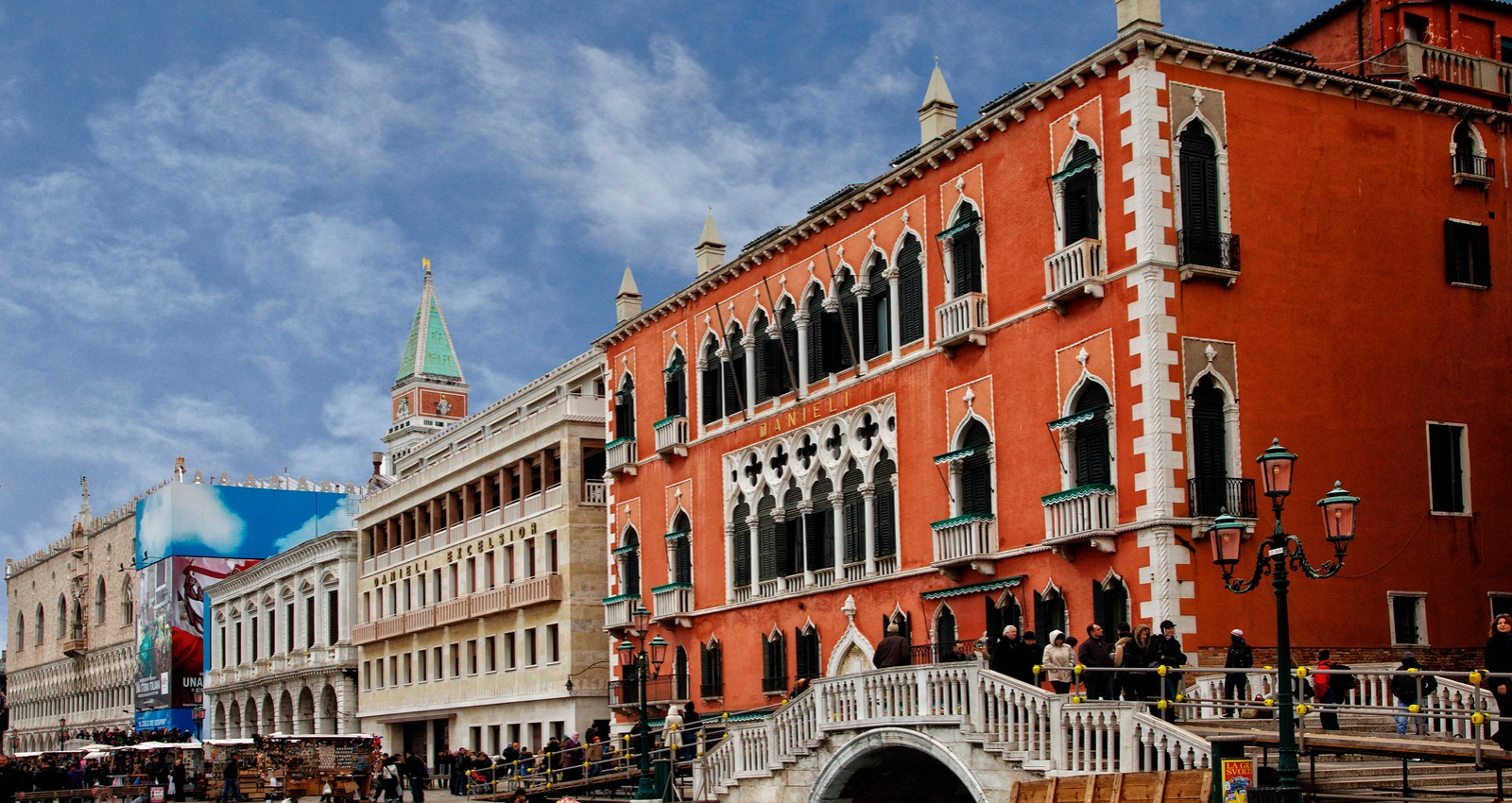
Buying up loan tranches on the bet that hotel rates will climb (still further)—that's what a British fund has done, wagering on the debts of Italy's luxury hospitality sector by pouring in a wave of capital. On one side of the coin it's pure finance; on the other lie the doubts over the "purity" of these properties, of which Confindustria Alberghi speaks. In short: why should we take a close look at a deal worth a full €550 million?
The Danieli in Venice, the palazzo on the Riva degli Schiavoni—two of the magnificent tourism properties of the ancient Serenissima—appear together in a financial operation by the investors of a London hedge fund headquartered at 7 Clifford Street, London. The revelation came from the Financial Times, recently picked up in Italy by Il Sole 24 Ore in an article by Laura Cavestri on 18 August.
The fund is TCI, formerly known as The Children’s Investment Fund and today TCI Fund Management (UK) Limited, run since May 2003 by British billionaire Sir Christopher Anthony Hohn, aged 60 and with a portfolio of at least $77 billion.
According to the news that circulated last month in Europe’s main financial dailies, the fund purchased loan tranches worth around $636 million (just under €550 million), focusing exclusively on financing for Italian luxury hôtellerie.
In short, with this operation TCI—rather than betting on buying the hotels outright—chose to position itself as a lender by taking over the creditor’s loan tranches: that is, a financing company belonging to Martin Frass-Ehrfeld, an investor who had himself financed the hotel properties in question. It’s also worth noting that TCI holds a stake in Ehrfeld’s company, the very one from which TCI—we repeat—acquired the loan tranches.
The largest loan concerns the Danieli ($392 million), and the other properties involved in the deal are the Caesar Augustus on Capri ($132 million), the Six Senses on Lake Como ($74 million), and the Mandarin Oriental in Milan ($38 million). To be clear: the hotel properties are, and remain, owned by Statuto, an Italian real-estate group chaired by Giuseppe Statuto.
The logic behind this type of investment, highlighted by Beatrice di Marco, an analyst at JLL, would appear to be a bet on the certainty that hotel rates will keep rising—driven by international demand, which is climbing, and by the availability of luxury assets of this kind, which is falling.
To decode the operation, then, is to understand that certain foreign funds—like the one we’re discussing—consider Italy’s tourism economy to be growing, and rightly so, to the point of buying up the very credit of companies that some Italian hotel properties have taken on as debt. The real speculation, in short, lies in the profit generated by the yield on the acquired credit.
According to JLL Italia (a long-standing leader in professional services and investment management for the real-estate sector), in the first half of 2026 alone, Italy’s Hotels & Hospitality segment saw “direct investment reach around €400 million, to which a further €200 million can be added from conversion operations, predominantly from offices into hotel properties.”
Again according to JLL Italia’s analyses this year (July 2026), “almost 80% of investors plan to increase their exposure to Italian hotels over the next 12–24 months, while around three-quarters of respondents expect to be net buyers of hotel assets in the country over the same period.”
So far, we understand that Italy’s tourism assets—even when at times saddled with debt—are the object of significant financial operations, and that is encouraging. Tourism, however, is not made of money alone but also of experiences; and what comes into the crosshairs is not so much foreign financing as the sale of properties and of those distinctive family-run hotel businesses that were born in their local area, know it intimately, and understand how best to offer it to the visitor.
Confindustria Alberghi commented on precisely all this in a note published this past July. On the one hand, the association’s president, Elisabetta Fabri, considers the injections of international capital a “positive signal”; on the other, she holds that “the fragmentation of the sector and ungoverned generational handovers put the Italian identity of hospitality at risk.”
In essence, Fabri focuses on all those family-run hotel businesses that, owing to “complex” generational handovers or management difficulties, “give way to capital with no ties whatsoever to the local area, instead of growing and consolidating while remaining Italian.”
Foreign funds, yes—but above all, safeguarding the soul and identity of our tourism properties.
Andrea G. Cammarata