




Claude and Gemini are still absent, but recently it has become possible in Italy too to buy advertising on ChatGPT. For the promotion of hotels and tourism operators, a new channel for promotion and direct sales is opening up.
From “Google Zero” to “100 per cent AI” and the way the manner of getting seen online is changing for tourism operators—we explained all this on Italy Travel Experience Magazine in a long analysis published here. It is artificial intelligence sliding its way into the tourism advertising market.
In essence, to promote your property it is no longer necessary to go through the web; you can do it by placing it directly within the answers of artificial intelligence. Among the giants of a technology that is upending everyone’s lives, Gemini and Claude are absent, not yet having equipped themselves with comparable advertising tools. With the new features introduced fairly quietly on Sam Altman’s platform, since 31 August hotels have had the option of buying advertising space. Anyone who regularly uses this generative model will have noticed pop-ups inviting them to promote their business or professional activity.
A different chapter in the manual of advertising techniques for tourism operators, who now discover the opportunity to choose a further channel for promoting their accommodation. From here, some might choose to break away definitively from traditional investments in search engines, social media, and online booking platforms.
ChatGPT’s advertising experiment had begun in the United States in early February this year, before reaching 31 European markets in late summer, Italy included. According to the company’s statements, by the end of August the platform had already reached an “annualised” revenue (that is, a hypothetical estimate) of one billion dollars, boasting tens of thousands of advertisers.
But how much does it cost a hotel to advertise on AI? The minimum investment is €15 per day, equivalent to around €450 for a thirty-day campaign. The system mainly provides two purchasing methods: cost per thousand impressions and cost per click. For the latter, the platform itself suggests an initial maximum bid of between $3 and $5 per click; advertisers are free to set their own budget and adjust their bids.
We ran a calculation simulation at an effective cost of €4 per click. In this case, a hotel would spend €400 for a hundred clicks to its own website. Assuming that four of these visitors complete a booking, the advertising cost to acquire each customer would be €100. For short stays—for example, a weekend in a small bed and breakfast—this would, of course, be a barely sustainable investment, if sustainable at all. By comparison, with an OTA—which generally applies a commission on completed bookings—pay-per-click advertising entails a significant risk: the tourism property ends up paying for the clicks even if no one books.
How Advertising on Artificial Intelligence Works
The difference compared with traditional search engines concerns above all the context in which the ad is presented. A tourist who asks the generative model where to spend a romantic weekend in Sicily, or which hotels to choose for a week in Bologna, might see an advertisement relevant to the conversation.
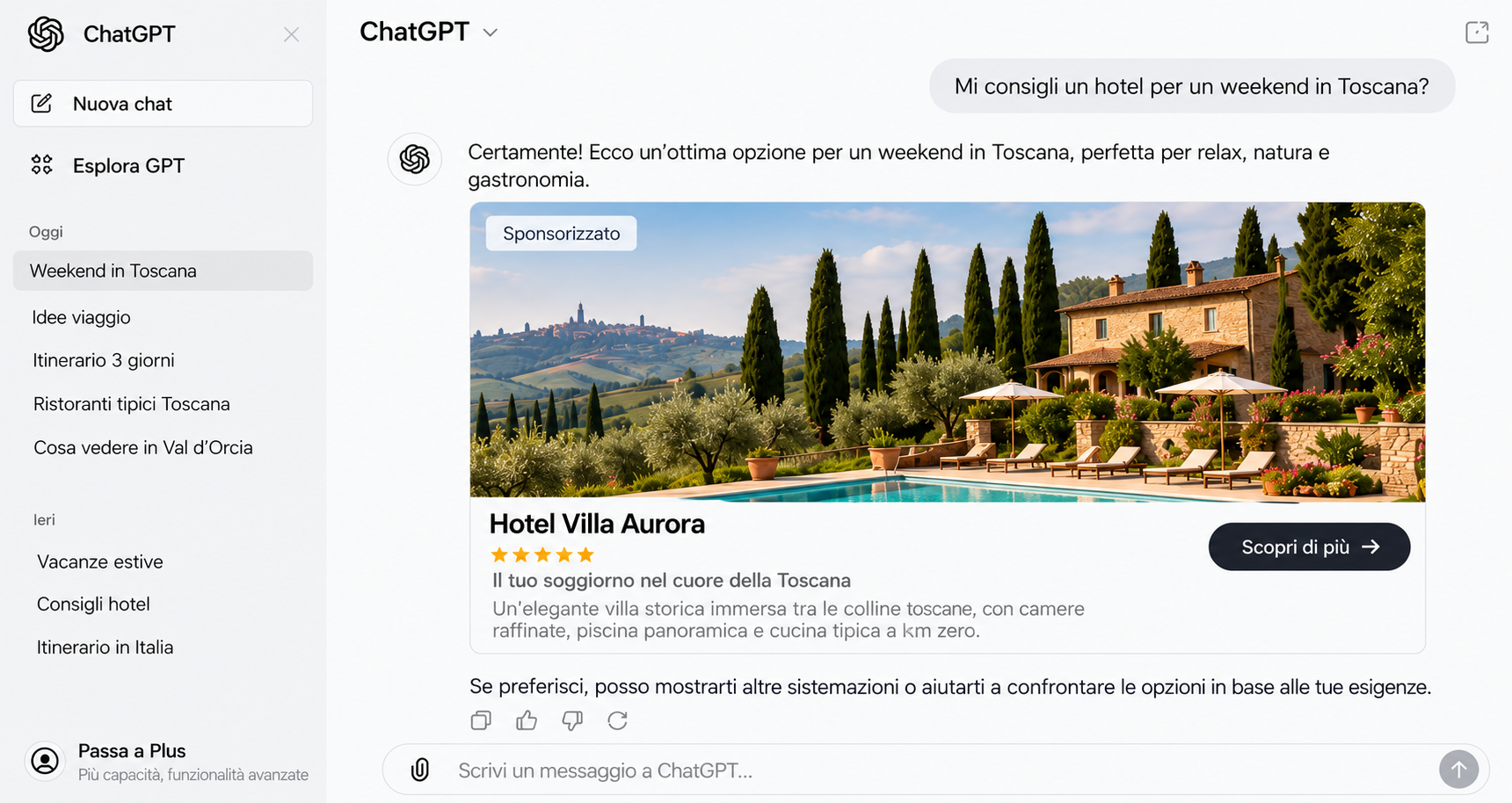
The advertiser can indicate topics, keywords, and contexts of interest, but cannot buy guaranteed presence in a given answer. The ads are identified as sponsored content and remain separate from the answers generated by artificial intelligence, as can be seen from the image accompanying this article.
It goes without saying that an ad of this kind is not comparable to the traditional promotion an operator can obtain through advertising on a newspaper page—far richer in content, details, ideas, photos, and information useful for telling the story of the tourism experience on offer.
In any case, to launch an AI campaign, the hotelier must register in the platform’s advertising section, create an advertising account, choose the objective, define the geographic market, set the budget, and upload the promotional content. There is the possibility of monitoring impressions, clicks, spend, and conversions.
Of note, the advertising is shown to eligible users on the free plans, while it remains excluded for those with a paid subscription. Not all users, therefore, constitute an audience reachable by the ads. For example, excluded are precisely those big-spending users who can afford costly subscriptions to use AI.
New Competition for Search Engines?
For the hotel sector, it is a promotional method that adds to the existing ones and can complement a presence on those channels able to generate visits to one’s own website. In the case of generative language models, users are intercepted not only when searching for a property, but also in the stages before booking—that is, during those artificial conversations in which they weigh up destinations, prices, and services, or even intimate wishes, together with the AI.
Given the baleful role—comparable to a virtual conscience—of generative models that now interact with people day and night, the impact of an advertising campaign could be truly devastating.
The positive side. A choice of this kind could offer independent properties a further opportunity to promote their brand and encourage direct bookings, reducing at least in part their dependence on intermediaries—those booking giants that all industry experts know well.
Like any business action, spending money on AI advertising involves risks and unknowns. Altman’s advertising platform is still young, and no sufficiently solid data has been released to establish the average cost of acquiring a hotel booking, or data useful for comparing the profitability of ChatGPT Ads with the giant Google Ads and other digital channels.
Google Gemini, as we mentioned, does not currently include advertisements directly in AI conversations, but it has nonetheless integrated new promotional formats into AI-assisted searches—on the search engine, however.
Claude, which according to the company Anthropic itself has developed a more “ethical” AI model, follows a different strategy instead. In February this year, Claude’s company announced its intention to keep its platform free of advertising, in order to protect the independence of its answers and the relationship of trust with users.
Andrea G. Cammarata