



The BBC and travel in miniature: Italy has been at it for ages—we just hadn't noticed.
Yes to the Dolce Vita—and if anyone still thinks that pizza and mandolins, corner shops and Lambrettas are stereotypes dragging down the Belpaese‘s power to attract tourists, they’re mistaken. The trend was recently chronicled by the BBC, and it’s that of the tiny tourist—the traveller in miniature who dutifully observes at least rule number one: “if it looks like a tourist thing to do, don’t do it.” The tiny tourist’s ten commandments include ritual activities and things to pack, such as buying a notebook to keep a travel diary, photographing the dogs you meet in the street, visiting the local minimarket, wandering and getting lost in old town centres, and even doing your laundry at a launderette and striking up acquaintances.
Laura Hall, the BBC journalist, wonders whether tiny tourism is the antidote to mass tourism. She sets off for Dublin to find answers. She discovers that travelling tiny, in the Irish capital, means saying no to the Guinness factory and devoting yourself instead to other micro-details in order to “understand a place better.”
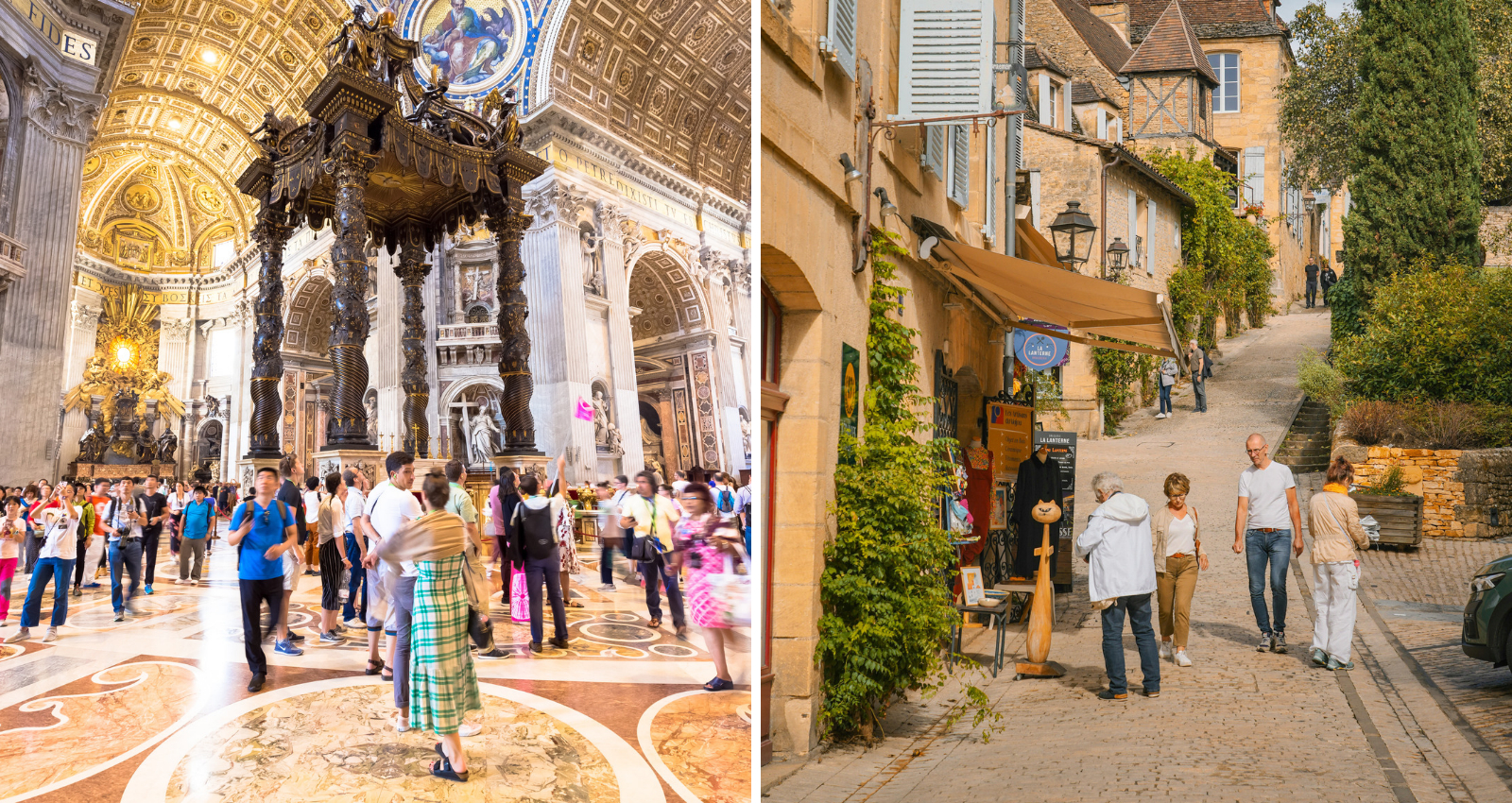
So, steer clear of the perfect “Disneyland” village, and seek out the less polished one instead—even one with historic buildings falling into ruin. It may sound brutal, but it means choosing holidays free of the spectacle that the super-destinations foist on us, and it helps the traveller come away with the impression of a deeper trip.
To recap, in Belpaese terms: no to visiting the Colosseum, no to the Leaning Tower of Pisa—but no, too, to the crowded beach in Riccione or the trendy spot on the Costa Smeralda. Permitted, instead, are chats with the shopkeeper and striking adventures—perhaps the discovery of a minimarket in the Apennines of Casteldelci, the only one serving a wonderful village that sits like a saddle in front of the Monte Fagiola, among hazy promontories that trace the boundaries of at least two regions, Emilia-Romagna and Tuscany. On that note, a 2025 British Airways survey reveals that 54% of British travellers are inclined to visit a supermarket as a tourist attraction during their holiday.
Detail and the exclusivity of the experience are the ingredients that fill the tiny tourist’s holiday. Tiny, yes—but not necessarily on a small scale. And so this new anthropological category of tourist can also travel to chaotic Milan—certainly not to head to the Duomo and hail the Madunina, but for a quick stop at a vintage clothing shop or a collectors’ vinyl store.
The tiny tourist, by belonging to this particular category of traveller, seeks alternatives to mass tourism. And do they find those alternatives in the picturesque, in those stereotypes of Italy—all pizza and spaghetti? Yes—because in Italy, without ever really asking ourselves the question, through our attachment to regional traditions, culinary or architectural, our love of detail, our pursuit of perfection in small things, our peculiar little villages of four houses, or the Piazza delle Sette Chiese, we made tiny tourism possible—turning it into a fully realised travel experience as far back as Goethe’s day, with his Italian Journey.
Modern times and tiny tourism. According to the 21st Censis report (2025), 38.1% of Italians have felt the need to do a “social detox” at least once. Unplugging from hyper-connection involves the recovery of old rituals—so chatting with the assistant at the vintage shop works better than shopping on Vinted, and discovering the neighbourhood wine bar with its selection of local wines works better than downloading the most highly rated wine app.
By nurturing the sense of belonging that identifies them within a group—physical or digital—the tiny tourist thus renews their own identity, choosing a way of travelling that enriches them through the details of that valuable picturesqueness with which Italy is endowed. The tiny tourist favours human interaction, contributing to the psychophysical wellbeing of themselves as a traveller and of those who live in and serve that territory.
Tiny tourism, then, rekindles the human and social side of travel. And for tourism operators, that means: different customers, different needs. Better a weekend spent watching the pots of cyclamens on the balconies of a Tuscan village, or Vincent van Gogh’s Vase with Tulips in a museum with endless queues? The choice is yours.
Andrea G. Cammarata