




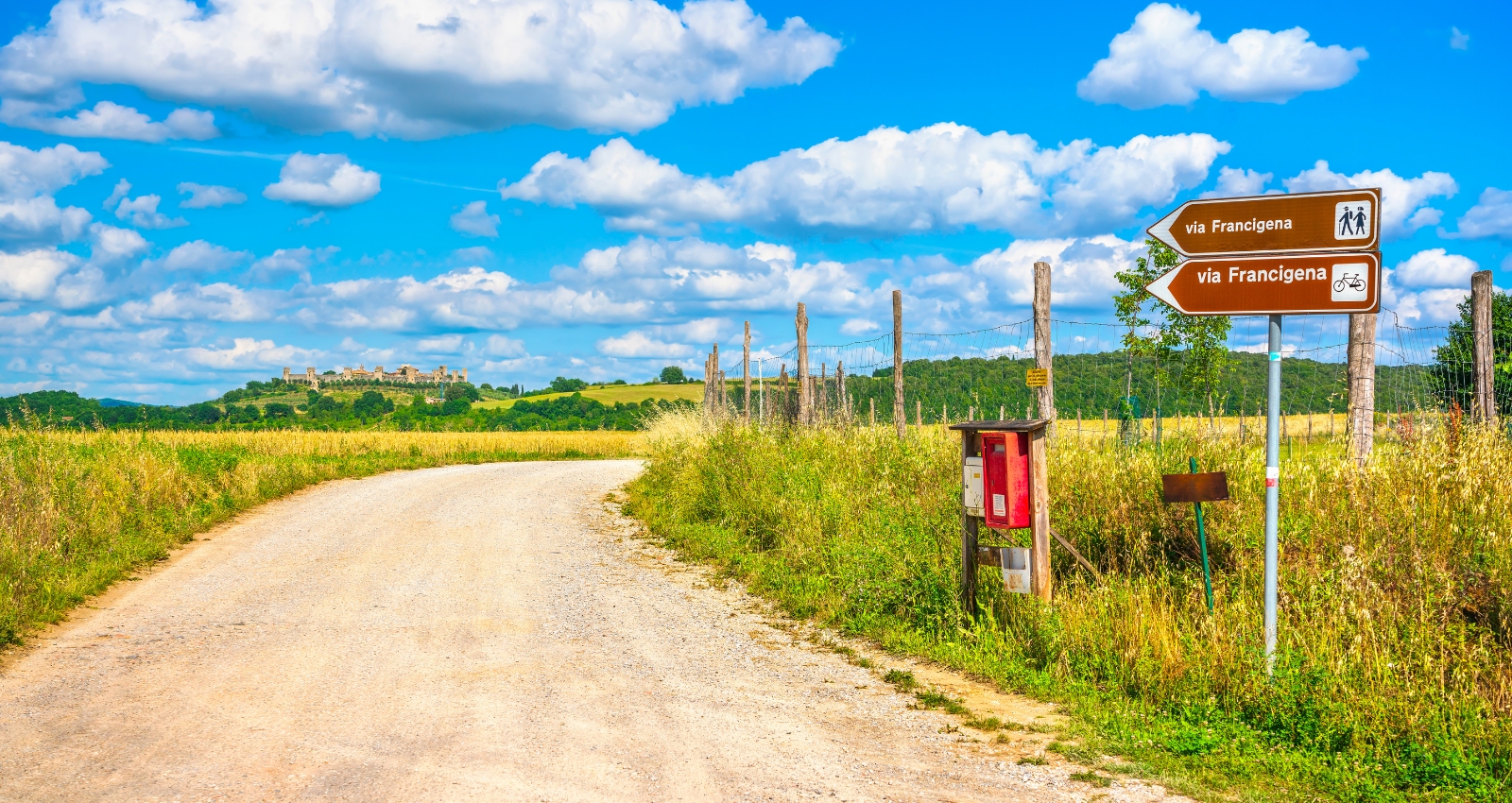
The Via Francigena is drawing microfinancing from the EU for the tourism of those who travel on foot, with an eye to the green transition and digital innovation.
A total of €200,000 has been awarded to eight different projects, implemented along the Via Francigena thanks to the European programme Detour, which supports the development of slow and responsible tourism. Each proposal that made the cut secured a small grant of €25,000. The funds are allocated within the framework of the aforementioned project, whose aim is to develop tourism ecosystems along the Mediterranean’s itineraries. In the background lies the goal of forging stronger connections between tourism, local communities, and the territories crossed by the routes involved.
Coordinating Detour is the Municipality of Fidenza, which is also home to the European Association of the Via Francigena Ways. Detour, as we mentioned, was set in motion by the European Union under the Single Market Programme and has an overall budget of two million euros for the 2024–2027 period.
Through a public call, the project provides financial support to small and medium-sized tourism operators along three other European trails besides the Via Francigena: the Lycian Way in Turkey, the Sultan’s Trail in Bulgaria, and a network of mountain itineraries in Greece.
All of the project’s objectives are linked by a common thread aimed at strengthening the competitiveness of small and medium-sized enterprises through the green transition, digital innovation, and the development of new services for walkers.
The funding is disbursed following training and mentoring sessions run by Detour. The selected groups—as the initiative’s official website states—will tackle a series of challenges to be built into their business plans. These include accessibility and community engagement, but also flexible hospitality, regenerative tourism, food-and-wine experiences, and the enhancement of local heritage.
Among the selected initiatives are: “Un Dedalo di Storie” (A Labyrinth of Stories), in Lombardy; “Food for Wellbeing Routes” (Lombardy, Emilia-Romagna, Liguria, and Tuscany); “17 TrasformAZIONI” in Emilia-Romagna; “Cambio Passo” (Changing Pace), between Liguria and Tuscany; “Francigena Living Network,” in Tuscany; “Therm&Trek” and “Oltre lo sguardo, dentro il cammino” (Beyond the Gaze, Into the Journey), in Lazio; and “Francigena Women – La Via delle Amazzoni” (The Way of the Amazons), also in Lazio.
Those involved will have eight months to meet the challenges outlined above, while also working on cycle tourism and inclusion. Among the winning ideas are “relay vegetable gardens” and tours designed to revive the weaker, less-travelled stretches of the route, then ranging across luggage-transport services and storytelling through podcasts.
In short, the Via Francigena is a vast “testing ground” through which Detour seeks to contribute to ongoing efforts to develop a serious alternative to an outdated economic-tourism model that generates nothing but overtourism.
The Francigena, then, is not merely a destination but also an experience to be lived. A route where hospitality, local products, territory, and physical and mental wellbeing become a single service to offer the visitor. And a vision of Made-in-Italy tourism that—beyond the great cities of art—looks to more or less undervalued trails where an experiential Belpaese reinvents itself.
Detour has already been put forward as a model of “good practice and cooperation between itineraries” at the 14th Forum of the Council of Europe. The winning projects were presented this past 9 September in Florence, at the headquarters of the Tuscany Region.
Andrea G. Cammarata