





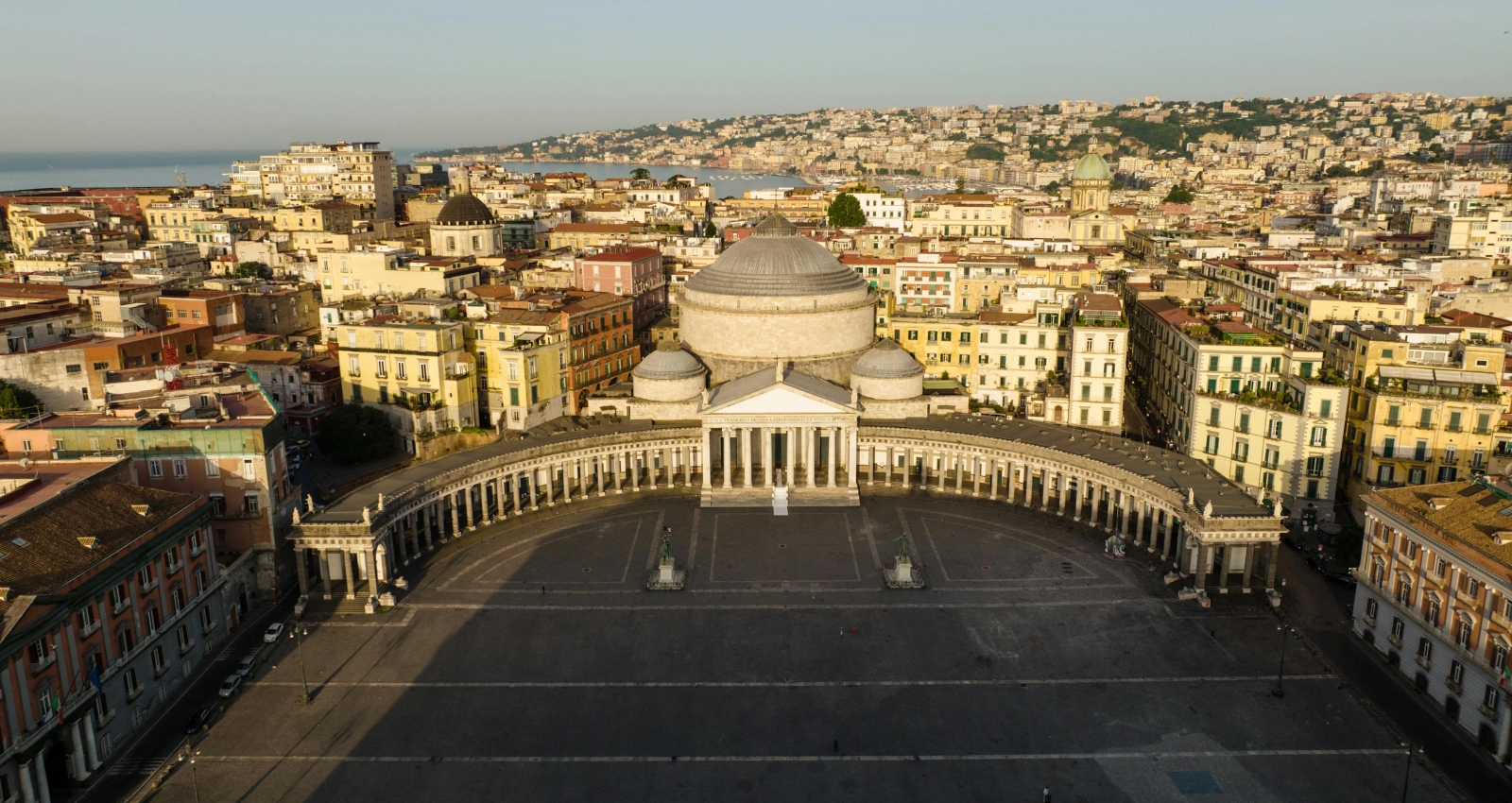
Keeping the tourism machine running by renewing what's on offer and connecting different players produces a positive effect on both community and territory.
The Fondazione Comunità Napoli Centro and numerous social cooperatives have joined forces to reopen Naples’ hidden domes to the public. Visitors can discover them while listening to the stories of young guides who come from more or less disadvantaged backgrounds and have found their place thanks to anti-mafia associations, regional training courses, and the National Civil Service programme.
In short, looking down on the “porous” city—as Walter Benjamin called it—from above is today also becoming a symbolic gesture. A concrete example of how a model of innovative tourism can integrate the social dimension of the Campania region.
The initiative has drawn the attention of the national press, and the authoritative il Post covered it here in a thought-provoking piece that recounts how tourism operators and foundations—but also regions, municipalities, associations, and social cooperatives—can work in dialogue and coordinate with one another to improve a place’s tourism offering while making a positive impact on the community and on urban hardship.
On the one hand, visitors gain access to a wider “availability” of things to see in Naples, with new monuments, domes, and historic churches to discover alongside those who were born in these places, live in them, and know their identity and representative value inside out. On the other hand, there are the positive repercussions for the community itself, which gains professional employment by putting people to work in quality jobs that are cultural in nature, or that revolve around culture.
Setting the gears of this initiative in motion, as we mentioned, is the foundation Comunità Napoli Centro, which first has the domes and churches restored, then entrusts them to a network of cooperatives that take over their management—organising cultural activities and, above all, hiring at least 150 people, all of them young and employed under proper contracts.
Around ten previously inaccessible sites can already be visited thanks to the project. Let’s start with the deconsecrated church of Sant’Aniello a Caponapoli, with its remains of the ancient Greek walls; more recently, Donnaregina Vecchia and Donnaregina Nuova have also reopened.
Then there is the museum dedicated to the sculptor Jago and the Cristallini “Blue Church,” but also the Fontanelle Cemetery—the shadowy protagonist of the plague dead of the mid-seventeenth century, and today returned to the city bearing the signature of Renzo Piano. The package of new tourism offerings also includes the majestic cloisters of the Augustinian convent in the San Lorenzo area, and Vasari’s sacristy in the church of San Giovanni a Carbonara.
Many of these initiatives take place in the Sanità district, where holiday rentals are very few and tourism—besides being non-overnight—is heavily cultural in character. In short, an offering that adds a more relaxed option compared to the crowding of the Spanish Quarters. A demonstration of how an experiential product can be built from scratch, taking root even in an extremely difficult yet stunningly beautiful neighbourhood like the Sanità.
The idea rests on a revenue model that gives tourism operators pause for thought. Most of the visits are free, and only at the end do the guides ask for a voluntary donation as they tell their own stories. For certain special visits, such as the rooftop tours, an entrance ticket has instead been introduced. A delicate balance between social commitment and economic sustainability that, it must be said, many Italian destinations have yet to implement.