


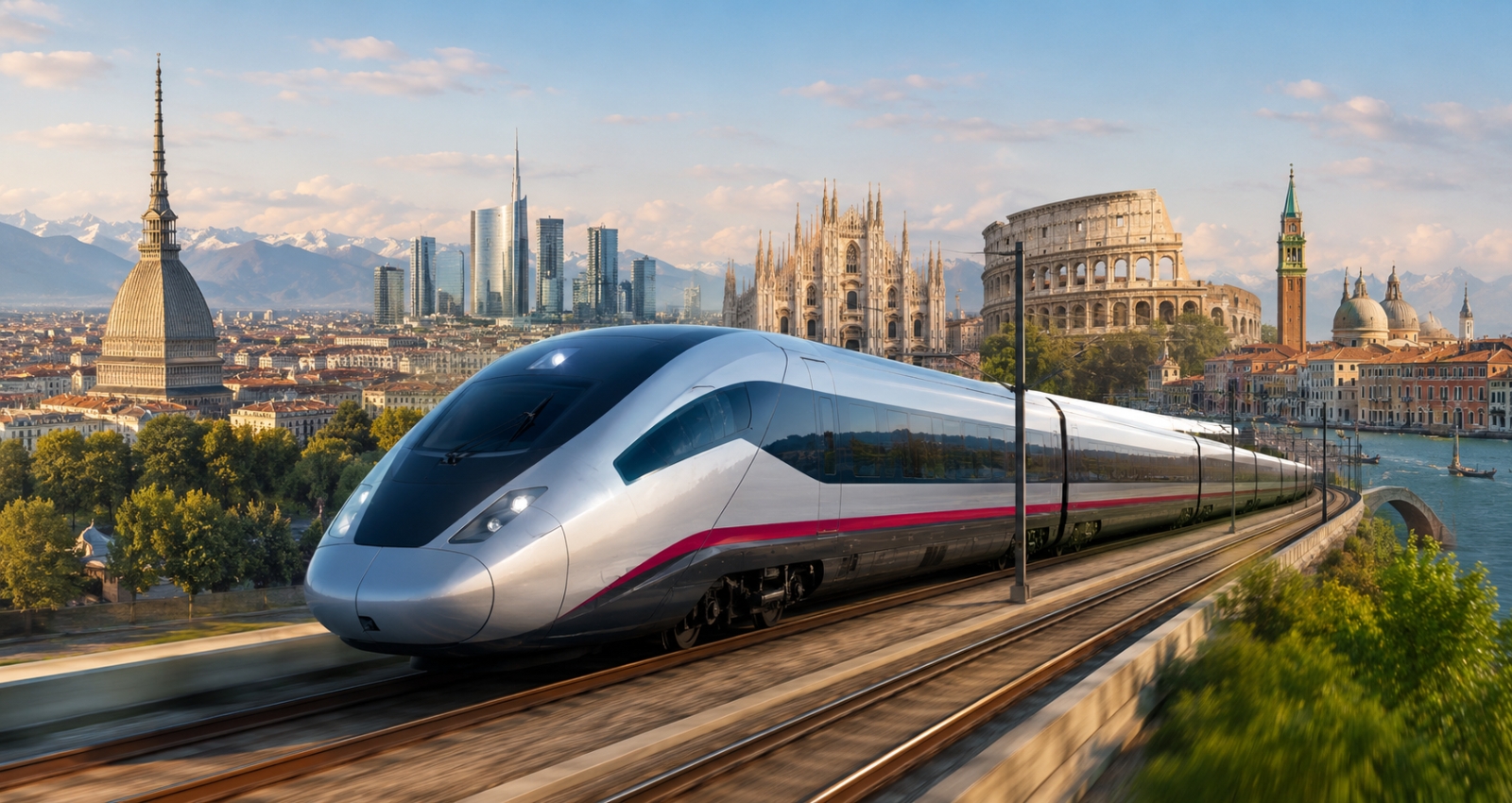
The Italian Competition Authority’s March 2026 decision opens the high-speed rail market to a new competitor. From 2027, French TGV trains will connect Turin, Milan, Rome and Venice. For the tourism industry, this could mean greater capacity and, based on precedents elsewhere in Europe, lower fares.
Italy’s high-speed rail market is entering a new phase. In early March 2026, the Italian Competition Authority, the Autorità Garante della Concorrenza e del Mercato (AGCM), accepted and made binding the commitments submitted by Rete Ferroviaria Italiana (RFI), paving the way for SNCF Voyages Italia to enter the market as a third operator alongside the long-established Trenitalia and Italo.
The move marks the end of the duopoly that has become firmly established in recent years within the most profitable segment of passenger rail transport.
The decision follows an investigation launched by the Competition Authority in March 2025 to assess a possible abuse of dominant position in the management of access to the high-speed rail network. The inquiry focused on the procedures used by RFI to allocate rail capacity, which were considered potentially capable of hindering the entry of new operators. The agreed solution is intended to open the market to genuine competition.
RFI’s Commitments
At the heart of the agreement is the allocation to the new entrant of a minimum package of 18 daily train paths, guaranteed for ten years, on Italy’s main high-speed routes: the Turin–Milan–Rome and Turin–Milan–Venice corridors. RFI will also be required to update the rules contained in its Network Statement in line with European principles. A transitional framework will give new operators priority access to available or underused network capacity. From an operational perspective, SNCF plans to enter the Italian market in September 2027 with its new double-decker TGV M trains, which will connect the main transport hubs in northern and central Italy. The French company welcomed the decision, while stressing that the immediate allocation of an initial share of train paths is essential before it can begin implementing its investment plan. According to the group, the operation may not be economically sustainable unless it can run at least 13 daily return services.
Lessons from the European Market
To understand what could happen in Italy, observers are looking at countries that have already liberalised their high-speed rail markets. The most frequently cited example is France, where the arrival of Trenitalia contributed to fare reductions of 43% on the Paris–Lyon route, 29% on Paris–Marseille and 19% on the international Paris–Milan service. Spain, which opened its high-speed rail market to competition in 2021, is also regarded as a successful example of how competition can affect both ticket prices and service quality. Should the same dynamics emerge in Italy, the benefits would be felt directly by passengers and, in turn, by tourism businesses developing products based on rail travel. More competitive fares and a wider range of services would make rail an increasingly attractive option for travelling between Italy’s major art cities. This would offer clear advantages for multi-destination itineraries and for the domestic mobility of international visitors once they have arrived in the country.
Part of a Broader Development Strategy
The opening of the market to greater competition comes at a time of substantial investment in Italy’s national rail infrastructure. Around 400 additional kilometres of high-speed railway lines are expected to open between 2026 and 2030. The projects include developments in southern Italy, the Brescia–Verona–Padua line, the Florence high-speed rail bypass and the Third Giovi Pass connection between Genoa and Milan. For the tourism supply chain, the message is clear: the rail network used by visitors travelling across Italy is becoming more extensive and potentially more affordable. The new operator is scheduled to begin services in 2027, but the foundations for a more competitive Italian rail market have already been laid.